Dirty Business, Sewage, Agriculture and Why Real-Time Data Matters
Channel 4’s Dirty Business has brought renewed public attention to the scale and complexity of the UK’s water quality challenges.

Channel 4’s Dirty Business has brought renewed public attention to the scale and complexity of the UK’s water quality challenges.
The documentary highlights sewage discharges from Combined Sewer Overflows (CSOs), regulatory pressures and the strain placed on ageing infrastructure, all contributing to an important national conversation.
It also reinforces something many across the sector already recognise: sewage is only part of a much wider and more dynamic picture.
Across the UK, river health is influenced by multiple, overlapping pressures. During heavy rainfall, CSOs may activate to protect homes and communities. At the same time, diffused agricultural runoff can carry nutrients such as nitrates and phosphates, alongside slurry, sediment and pesticides, into nearby watercourses. Urban drainage systems transport contaminants from roads and hard surfaces, while industrial outflows may add further complexity.
In many catchments, several of these influences occur simultaneously.
If we are serious about restoring rivers, the critical question is not simply how much pollution is occurring, but how we identify where it is coming from, how severe it is, whether it is recurring, and how quickly it can be addressed.
A single stretch of river can be affected by multiple events at once. A CSO discharge may coincide with rainfall-driven runoff from surrounding farmland. By the time a visible impact is observed downstream, the source may be miles upstream and hours in the past. Traditional monitoring approaches, periodic sampling and retrospective reporting, provide valuable insights, but they can struggle to capture short-duration or fast-moving events in real time.
This is where continuous environmental intelligence becomes transformative.
When WATR was conceived in 2016, the ambition was straightforward: use real-time water quality data to support better environmental decision-making. While the scale of today’s public focus was not yet clear, one principle was, better data enables better outcomes.
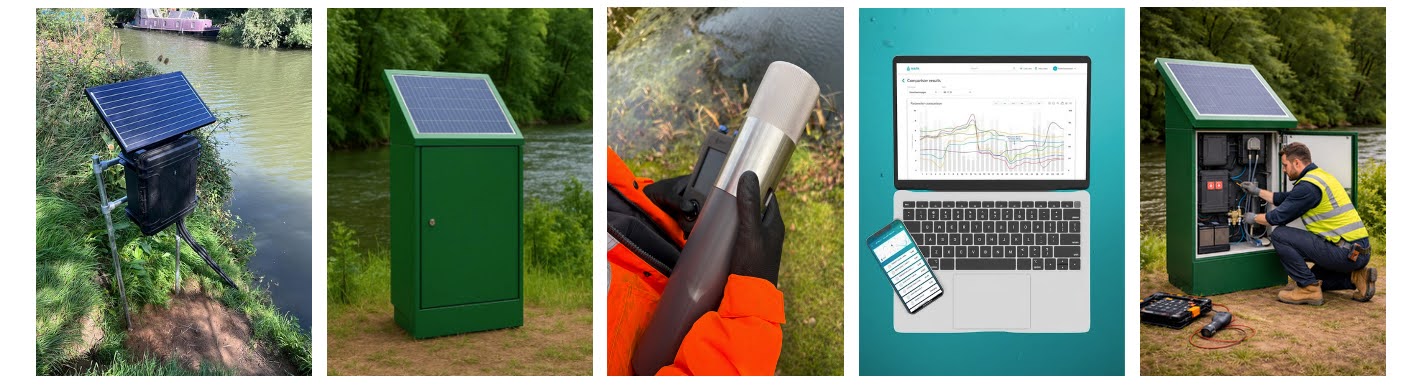
Today, WATR delivers continuous, multi-parameter monitoring from almost anywhere in the world. By measuring indicators such as dissolved oxygen, turbidity, ammonia, conductivity, temperature and nutrient concentrations, it becomes possible to distinguish between different types of pollution events.
Different sources leave different signatures.
- Sewage-related discharges may present as elevated ammonia combined with falling dissolved oxygen and increased conductivity.
- Agricultural runoff following rainfall can show rising nitrates and phosphates alongside increased turbidity.
- Sediment-heavy runoff may drive turbidity without the chemical markers associated with wastewater.
When these parameters are tracked continuously and layered with rainfall data and known infrastructure locations, patterns begin to emerge. A spike that coincides with rainfall but not with a CSO activation may suggest diffuse agricultural influence. A discharge during dry weather may indicate network pressures requiring investigation. Recurring seasonal patterns can highlight upstream land management dynamics.
This shift changes the conversation.
Instead of asking whether there is a problem, we can ask:
- Where is it originating?
- How frequently is it occurring?
- How severe is it?
- Where should investment be prioritised for maximum environmental benefit?
With more than 14,000 CSOs in England alone and thousands of agricultural holdings across sensitive catchments, upgrading everything simultaneously is neither financially nor logistically realistic. The same applies to catchment-scale mitigation measures. Without high-resolution, continuous evidence, investment risks becoming reactive rather than strategically targeted.
Real-time monitoring provides clarity. It highlights high-frequency spill locations, identifies persistent nutrient loading, reveals dry-weather anomalies and supports transparent reporting. Most importantly, it enables proportionate, evidence-led prioritisation.
Public awareness is growing. The opportunity now is to translate that awareness into collaborative, data-driven action, combining infrastructure improvement, catchment management and continuous measurement.
Sewage is part of the challenge. Agriculture is part of the challenge. Climate-driven rainfall extremes intensify both. The common requirement is clarity.
Real-time data provides that clarity, enabling faster response, smarter investment and more resilient rivers.
We are proud to work alongside water companies, regulators and environmental stakeholders to support proactive, evidence-based water management.
If you would like to explore how real-time monitoring can strengthen catchment insight and prioritisation strategies, we would welcome a conversation.
Get in touch
WATR has been designed to improve water quality around the world by providing an easy, accurate and a reliable way of monitoring water conditions, if you have any enquiries or questions please get in touch. Send us your specific requirements and we will get back to you as soon as possible.